
Why Supply Chain Visibility Isn’t Enough

Updated: May 6
What Is the Biggest Problem in Modern Supply Chains?
The biggest issue in today’s supply chains is not a lack of data or visibility; it’s a lack of alignment.
Most manufacturers already have systems that track orders, production, and logistics. But when those systems don’t work together, organizations struggle to understand what is happening in real time or what actions to take next.
Without alignment, teams react to problems rather than prevent them.
Why Supply Chain Visibility Isn’t Enough
Visibility shows what is happening. Alignment explains why it’s happening, and what to do about it.
Over the past several years, manufacturers have invested heavily in:
ERP systems for orders and inventory
MES systems for production tracking
Logistics platforms for shipments
Supplier systems for procurement
Each system works independently, but when these systems are not connected, organizations face a common challenge:
Procurement sees supplier delays
Production sees downtime
Logistics sees late shipments
Everyone has part of the story, but no one has the full picture.

What Happens When Supply Chain Data Is Fragmented?
When supply chain data is fragmented across systems:
Root cause analysis takes days and multiple handoffs
Forecasting becomes unreliable
Inventory decisions become reactive
Disruptions cascade across operations
In one high-density manufacturing environment that Lifescale Analytics worked with, teams were monitoring over 130,000 data points across disconnected systems, relying on manual analysis to understand performance.
After our team aligned that data into a unified, real-time view:
Manual interpretation was reduced
Predictive maintenance became possible
Teams acted on issues as they emerged instead of days later
Why More Data Doesn’t Solve Supply Chain Problems
Adding more dashboards or collecting more data does not fix supply chain challenges.
More data without alignment often creates:
Conflicting metrics
Delayed insights
Increased complexity
Success comes from connecting insight to action, not collecting more information.
What Is Supply Chain Data Alignment?
Supply chain data alignment is the process of connecting data across systems so that all teams operate from the same, real-time understanding of operations.
This includes:
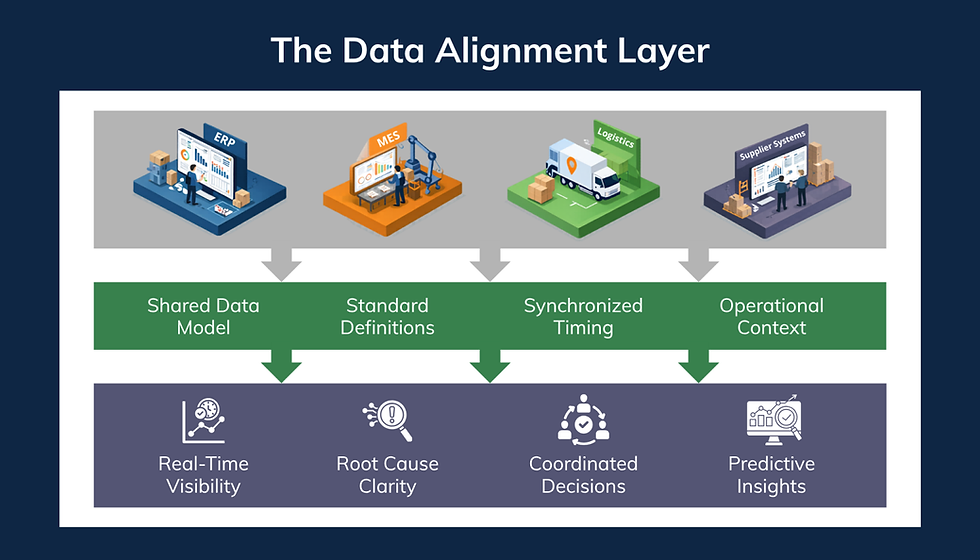
Creating a shared data layer across ERP, MES, and logistics systems
Standardizing key definitions (e.g., what qualifies as a “delay”)
Synchronizing data timing across platforms
Adding operational context to connect events across systems
Alignment does not require replacing existing systems; it ensures those systems work together.
How Data Alignment Improves Supply Chain Performance
When supply chain data is aligned, organizations shift from reactive to predictive operations.
Before Alignment
Teams investigate issues across multiple systems
Root cause analysis is slow and fragmented
Decisions rely on outdated or incomplete data
After Alignment
Disruptions are visible across systems in real time
Root cause is traceable from the supplier to production to delivery
Teams act from a shared, current operational view
This is where analytics and AI begin to deliver value, not as standalone tools, but as extensions of a strong data foundation.
What Can Aligned Supply Chain Data Enable?
Aligned data enables organizations to:
Anticipate supplier delays before they impact production
Adjust schedules dynamically based on real-time conditions
Optimize inventory without overstocking
Improve on-time delivery performance
Strengthen coordination across teams
These are not just analytics improvements; they are operational advantages.

Where Should Manufacturers Start?
Most organizations do not begin with full transformation; they start with one high-impact workflow.
For example:
Supplier delays affecting production
Inventory mismatches across systems
Scheduling inefficiencies
By aligning data around a single workflow, organizations create immediate value and a foundation to scale.
What Is the Best Approach to Supply Chain Data Alignment?
A structured approach focuses on:
Turning fragmented data into a connected foundation
Improving visibility across systems and teams
Enabling faster, more informed decisions
Supporting future AI and predictive capabilities
Programs like Lifescale Analytics’ Digital Data Advancement Program (DDAP) are designed to guide this process, starting with alignment and expanding into advanced analytics.

Key Takeaways
Most supply chain challenges are caused by misaligned data, not a lack of data
Visibility alone is not enough; alignment enables action
More data without alignment increases complexity
Start with one workflow, then scale across the supply chain
Data alignment is the foundation for real-time decisions and AI

The Leadership Question
The question for manufacturing leaders is not:
"Do we have supply chain data?"
the question is: The
"Can we see and act on the full supply chain picture in real time?"

Frequently Asked Questions
What is supply chain data alignment?
Supply chain data alignment is the process of connecting and standardizing data across systems like ERP, MES, and logistics platforms. It ensures all teams operate from a unified, real-time view of operations, improving visibility and decision-making.
What is the difference between data visibility and data alignment?
Data visibility shows what is happening across systems by making information accessible through dashboards and reports. Data alignment goes further by connecting and standardizing that data so it reflects a single, consistent, real-time view of operations. In short, visibility provides information, while alignment enables understanding and action across teams.
Why do disconnected systems cause delays?
Disconnected systems create delays because each one reflects only part of the operation. Without a unified view, it takes longer to identify root causes, coordinate responses, and make timely decisions across teams.
Can data alignment be done without replacing systems?
Yes. Data alignment focuses on connecting and integrating existing systems rather than replacing them. This allows organizations to improve visibility and coordination without a full system overhaul.
How does data alignment support AI?
AI depends on consistent, high-quality data to generate accurate insights. Data alignment ensures that information is reliable, standardized, and connected across systems, making it usable for predictive models and real-time decision-making.
Final Thought
Supply chain performance is no longer limited by data availability.
It is defined by how well that data is connected, understood, and acted on in real time.

Lifescale Analytics is a data analytics, engineering, and AI firm that helps organizations transform fragmented data into actionable insight. Since 2012, we have supported commercial and government clients in building data foundations that enable real-time decision-making, advanced analytics, and operational performance improvements.
Our expertise spans data science, cloud and infrastructure, cybersecurity, artificial intelligence, engineering, and geospatial solutions, delivering secure, scalable solutions backed by ISO 9001 and ISO/IEC 27001 certifications.


Comments